Metal Fabrication

custom metal fabrication

Custom Metal Fabrication Solutions for a Wide Range of Industries

At Metal Fabrication Professionals, we’re proud to serve a wide range of industries with reliable metal components. As a custom metal fabrication shop, we combine advanced technology, skilled craftsmanship, a deep understanding of the industries we support, and decades of experience to deliver the highest-quality results. Our team has the tools and expertise to get the job done right. 

Agricultural Equipment 

The agricultural industry depends on durable, long-lasting metal components that can withstand heavy use in demanding environments. At MFP, we offer custom metal fabrication capabilities that support agricultural machinery, equipment frames, brackets, and protective housings. 

With our combination of metal cutting services and welding and fabrication services, we ensure that every part is built tough enough to handle years of fieldwork. 

Automotive Equipment 

For automotive manufacturers and suppliers, precision and repeatability are non-negotiable. Our expertise allows us to deliver complex parts with tight tolerances. From custom metal enclosures to chassis components and supports, our sheet metal shop is equipped with top-notch tools and machines to keep projects moving efficiently. Our robotic welding services, in particular, are critical in producing consistent welds for high-volume production runs that are commonplace for this industry. 

Construction Equipment 

The construction industry relies on heavy-duty components that can endure the toughest job sites. Our services produce rugged and reliable parts such as brackets, housings, and frames for heavy construction machinery. Our comprehensive capabilities allow us to help construction manufacturers meet performance demands without sacrificing efficiency or cost-effectiveness. 

Elevators and Escalators

Safety and reliability are critical in this sector due to consistent use. MFP provides metal enclosures, supports, and panels for elevator and moving stairway systems. Our custom fabrication solutions deliver precise parts that comply with industry regulations. Whether for new installations or replacement components, we understand the critical nature of these projects and deliver accurate parts you can depend on. 

Forestry

Forestry equipment must perform in some of the harshest outdoor environments. That’s why we build tough, dependable components, from protective guards to structural components, to ensure forestry equipment is strong, safe, and long-lasting. 

Material Handling

In warehouses, distribution centers, and factories, material handling equipment is essential in daily operations. We fabricate racks, conveyors, carts, and other critical components for this space. Because downtime in this sector can mean lost revenue, our ability to deliver reliable, durable components on time makes us a trusted partner. 

Power Generation

Energy projects often require custom metal solutions built for safety, efficiency, and compliance. MFP has experience fabricating housings, enclosures, frames, and parts for the power generation industry. Our detail-oriented team can take on projects ranging from small-batch custom builds to large-scale production runs, while maintaining strict adherence to industry standards. 

Why Choose MFP for Your Industry?

At Metal Fabrication Professionals, we’re more than a sheet metal shop; we’re a true partner. With a full range of fabrication and machining services, we keep every step of your project under one roof. This reduces lead times, eliminates third-party delays, and ensures consistent quality from start to finish. 

We also maintain a strong focus on continuous improvement, and feel confident that our clear communication and efficient processes are key to delivering the best results to customers across a range of industries. 

Partner with MFP for Your Next Project 

The MFP team has built long-term relationships by consistently providing high-quality metal components tailored to customer needs. Whether you’re in agriculture, automotive, construction, or another industry entirely, our team is prepared to handle your next project with precision, reliability, speed, and responsiveness. 

When you’re looking for a custom metal fabrication partner, contact our team to discuss your next project.

Custom Metal Fabrication Solutions for a Wide Range of Industries Read More »
metal fabrication shop

Frequently Asked Questions We Hear at Our Metal Fabrication Shop

At our metal fabrication shop, we receive a wide range of questions from customers. Whether it’s about choosing the right fabrication process, understanding our quality control methods, or navigating the quoting process, these conversations help us ensure every project runs smoothly from start to finish. 

We’ve compiled some of the most common questions we hear at Metal Fabrication Professionals, along with straightforward answers to help you make informed decisions about your future projects.

Common Questions About Our Precision Metal Fabrication Services 

How does the MFP team determine which specific capabilities will be most effective for a customer’s project? 

The MFP team determines required services by reviewing each project’s specifications, materials, tolerances, and end-use requirements.

  • For sheet metal cutting, we choose between laser, waterjet, or plasma based on precision needs, thickness, cost, and heat sensitivity. 
  • For metal forming services, our team recommends roll forming for high-volume, smooth-radius parts or bending for shorter or complex shapes. 
  • Welding methods, including MIG, TIG, SAW, or laser, are selected based on volume, material, thickness, and application. 

Our team is open to suggesting process changes to improve cost or lead time while maintaining quality. Ultimately, each decision is tailored to the customer’s unique goals. 

What quality processes does MFP use to verify components?

MFP verifies component quality through a multi-step process integrated throughout production. 

  • Incoming materials undergo detailed inspections for defects and surface protection.
  • Dimensional accuracy is confirmed using calipers and micrometers to ensure adherence to tolerances. 
  • Operators and welders perform in-process visual checks, with welders following strict documentation and inspecting for porosity, undercutting, and size accuracy. 
  • Our QC department conducts a comprehensive final inspection, evaluating surface finish, weld integrity, and all specifications before shipping. 

Any discrepancies trigger rework or rejection, ensuring every component meets the highest quality standards before leaving our facilities

Best Practices for Partnering with a Metal Fabrication Shop 

What should I include in a request for quote (RFQ)?

For the most accurate and efficient quote from MFP, include both a 3D model and a 2D drawing when possible. 

  • A 3D model provides material details, exact geometry, and dimensions. This allows our quoting software to quickly identify required processes like cutting or forming.
  • A 2D drawing is especially valuable for complex projects, capturing details that aren’t in the model, such as weld instructions, assembly notes, or finishing requirements. 

Providing both reduces back-and-forth communication and ensures nothing is overlooked, preventing no-quotes and helping us deliver precise quotes faster. 

How can I communicate my individual goals regarding cost, lead time, and quality? 

When submitting your RFQ to Metal Fabrication Professionals, let us know your top priorities, whether that’s cost, lead time, or any other factor. Clear communication helps us recommend the right processes, materials, and timelines to meet your goals. For example:

  • If speed is essential, we’re able to adjust production methods to reduce turnaround time. 
  • If quality is key, we’ll focus on precision and finishing details. 
  • If price is the driver, we’ll identify the most cost-effective approach. 

Sharing your priorities upfront ensures we deliver results that align with your expectations from the start. 

Why Metal Fabrication Professionals? 

Why is it beneficial to partner with a one-stop metal fabrication shop

Working with a one-stop shop like MFP streamlines production by keeping all processes under one roof. This effectively: 

  • Shortens lead times
  • Eliminates shipping delays and costs
  • Reduces risk of damage in transit
  • Ensures consistent quality
  • Simplifies communication by offering a single point of contact 

With everything handled in-house, your project moves smoothly from start to finish, ensuring parts arrive on time, on budget, and to your precise specifications. 

How does MFP handle potential supply chain challenges associated with material sourcing? 

MFP mitigates supply chain challenges by maintaining a seven-figure steel inventory in our 250,000-square-foot facility. Stocking a wide range of common and rare materials allows us to start orders immediately, eliminating the days or weeks others spend sourcing steel.

This proactive approach protects customers from industry shortages that can delay or derail projects. 

What kinds of material does MFP have expertise with? 

While the two most common materials we handle are mild steel and stainless steel, our team has extensive experience with and expertise in a variety of metals. We understand that each material has unique properties that make it ideal for specific projects and applications, and we’re happy to educate our customers on the implications of opting for one metal over another. 

What’s the smarter choice: working with a large-scale manufacturer or a smaller shop? 

When selecting a manufacturer, OEMs have a big decision to make. Do they leverage the diverse machining services that a large shop has to offer? Or do they partner with a smaller-scale manufacturer with unmatched customer service? 

When buyers opt to work with MFP, they don’t have to make this decision. Our sheet metal shop has the advanced equipment and capabilities of a large manufacturing business, as well as the personalized experience that is rare for a shop of our size. 

Frequently Asked Questions We Hear at Our Metal Fabrication Shop Read More »

sheet metal shop

Finding the Right Balance Between Quality, Price, and Delivery: Expertise from Our Sheet Metal Shop

Customers trust our sheet metal shop to deliver precisely what they need, when they need it. But to meet your expectations, we first have to understand your priorities. To learn more about your project, we’ll often ask questions like: 

  • Does your project require tight tolerances and premium finishes?
  • Are you working within a tight budget?
  • Do you need a quick turnaround to hit an approaching deadline?

Whether quality, price, or speed is your number-one priority, our team can deliver what matters most without compromising in other areas. 

In this blog round-up, we offer an overview of MFP’s consistency in providing maximum value to our customers.

Top-Notch Quality, from Start to End 

At our metal fabrication shop, quality control is built into every step of our process, from material inspection to final shipment.

  • Each sheet is examined for imperfections upon arrival, and our team ensures protective coatings remain intact.
  • Throughout production, operators and welders perform detailed inspections, with welders documenting every step for accountability and accuracy. 
  • Dimensional checks using advanced tools guarantee parts meet exact specifications, and a final review by our quality control team ensures everything is up to standard. 

Read more about our rigorous approach to quality control. 

Cost-Effective Solutions: Meet Your Budget With Strategic Choices

For many of our customers, cost-effectiveness is just as important as quality. That’s why we go beyond cutting parts; we help cut costs strategically. Efficient nesting, strategic use of material remnants, and alternative material recommendations can preserve quality while lowering expenses. Backed by tools like Paperless Parts and SigmaNEST, we maximize every sheet and minimize waste. Most importantly, we keep the lines of communication open, collaborating closely with customers to deliver budget-conscious solutions. 

Check out our full blog, which details our team’s cost-effective solutions. 

The key to cost-effective part design? Avoid over-tolerancing!

Tighter tolerances don’t always lead to better parts, especially when they produce higher costs without adding real value. We broke down the difference between machining and fabrication tolerances in this blog, highlighting why understanding both is critical for cost-effective part design. 

Over-tolerancing can inflate quotes or even lead to no quotes from other sheet metal shops. That’s why our engineering team works closely with customers to align tolerances with end-use needs, reducing costs without compromising quality. With clear communication and upfront information, MFP helps you find the sweet spot between precision and affordability.

Fast Delivery for Even the Tightest Turnarounds 

When speedy delivery is your priority, MFP can make it happen. Our fabrication and machining services are adaptable and agile, so we can meet even the tightest deadlines. Here’s how:

How MFP’s on-hand inventory improves lead times

Every day counts in your production schedule. That’s why our sheet metal shop maintains a $2 million on-hand steel inventory inside our 250,000-square-foot facility. From common grades like mild steel to harder-to-find sizes of 304 and 316 stainless, our in-house stock helps our customers avoid common supply chain delays. 

Instead of waiting days or weeks for materials to arrive, we’re ready to cut, form, weld, and roll right away. Faster start times mean faster delivery dates, a game-changer for our customers in need of quick turnaround. 

Read more about the on-hand steel inventory we maintain in our Kentucky metal fabrication facilities.

Need expedited lead times? Not a problem

There’s a difference between needing parts “soon” and needing parts “ASAP.” That’s why we offer expedited services for jobs that require a quick turnaround—sometimes even with same-day shipping. If your part isn’t complex and utilizes in-stock material, we’ll do whatever it takes to deliver it as quickly as possible. Our large steel inventory, streamlined processes, and transparent communication allow us to keep projects moving when our customers are up against a tight deadline.

Take a look at our blog, which dives into how our sheet metal shop expedites jobs, as needed.

Contact Our Expert Team for a Quote 

At Metal Fabrication Professionals, we don’t operate with a one-size-fits-all approach. Our expert team thinks responsively, prioritizing what matters most to our customers in our cutting, forming, and welding operations. 

Contact our Louisville metal fabrication shop to get your next project started.

Finding the Right Balance Between Quality, Price, and Delivery: Expertise from Our Sheet Metal Shop Read More »

roll forming

Sheet Metal Bending vs. Roll Forming: What’s the Right Process for Your Project?

Selecting the right sheet metal forming process is essential for ensuring optimal efficiency, quality, and cost-effectiveness of your fabricated parts. Two commonly used methods in metal fabrication are sheet metal bending and roll forming. While both processes shape metal into the desired form, they have key differences that determine their suitability for various applications. Let’s dive into these differences and determine which service is most compatible with your next project.

Roll Forming for Efficient Results

Roll forming is a continuous bending operation in which a long strip of metal is passed through a series of rolls to gradually achieve a desired shape. This process is ideal for producing parts with consistent cross-sections, such as cylinders, cones, and rings.

Benefits of Roll Forming

  • Efficiency: Roll forming is a fast process that minimizes labor and reduces production time. 
  • Smooth finish: Because the metal is continuously shaped, roll forming produces a uniform appearance without visible break lines. 
  • Cost-effective for large runs: Once set up, roll forming can process large quantities of parts with minimal material waste, making it ideal for high-volume production. 

When to Choose Roll Forming

This is the preferred method when:

  • The part requires a consistent radius and smooth aesthetic. 
  • The metal is long enough to span across the forming rolls. 
  • The goal is to optimize efficiency and reduce labor costs.

Sheet Metal Bending: A Flexible, Cost-Effective Alternative 

Sheet metal bending, often performed using a press brake, involves clamping the metal and applying force to bend it into the desired shape. One specific technique within this method is bump forming, where segmented curves are created using a series of small bends.

Benefits of Sheet Metal Bending

  • Flexibility in design: This process allows for forming complex geometries like square-to-round transitions.
  • Ideal for shorter parts: Sheet metal bending can be used when a part is too short to be effectively roll-formed. 
  • Customizable radius: Bump forming can achieve various radii by adjusting the number of bends. 

When to Choose Sheet Metal Bending 

Sheet metal bending is typically the best option when: 

  • The part is too short to span across the rolls in a roll forming machine. 
  • A square-to-round transition or other complex shape is required.
  • The customer does not require a perfectly smooth finish and is seeking a cost-saving alternative to rolling. 

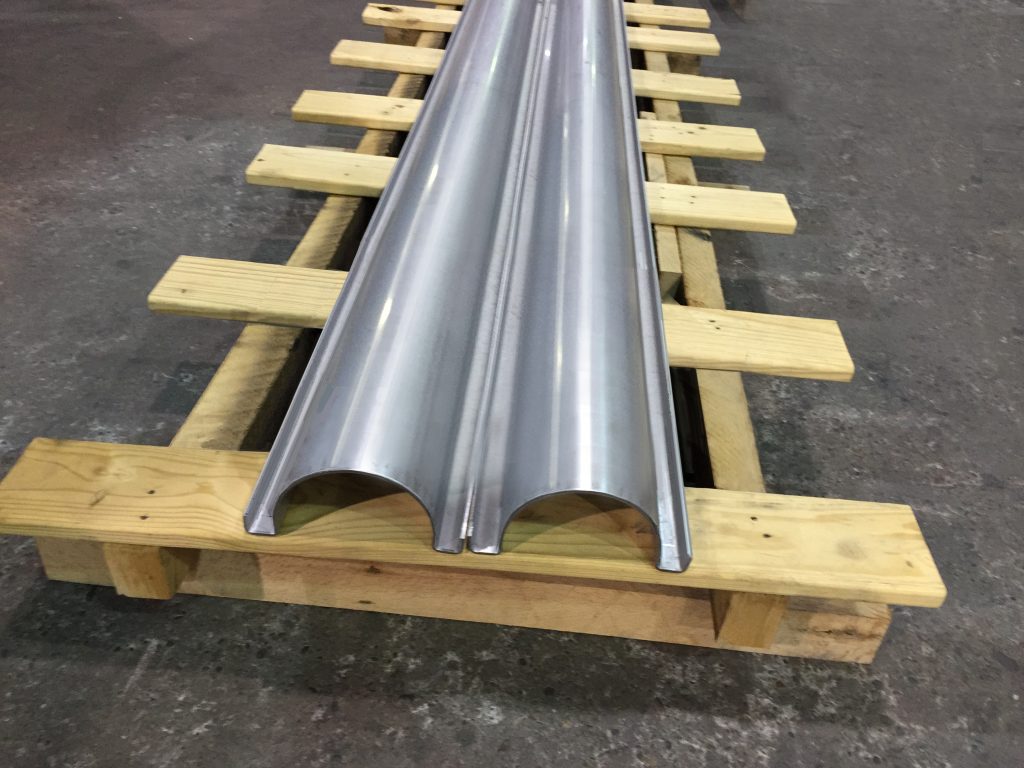
One recent customer of ours opted for sheet metal bending for the production of deer feeders. Initially, the feeders were roll-formed into two half pieces. However, the customer planned to cover them with rubber bark, eliminating the need for a perfectly smooth finish. Because cost-effectiveness was a priority for this customer, MFP recommended bump forming instead, using a press brake to create a segmented curve. This approach reduced production costs without affecting the products’ functionality. 

Comparing Roll Forming and Sheet Metal Bending

Here’s a simple side-by-side comparison to help guide your decision:

sheet metal bending

MFP’s Expertise in Metal Forming Services

At Metal Fabrication Professionals, we have the expertise and equipment to determine the best forming process for your project. We’re well-versed in precision sheet metal fabrication and ready to tailor our approach to meet your exact needs.

Why MFP? 

  • State-of-the-art equipment: Our facility has specialized machines for not only roll forming and sheet metal bending, but also a range of additional machining services—all to deliver precisely what you require. 
  • Experienced team: Our experts understand when to use each method for optimal results.
  • Customer-first approach: We help customers balance quality, cost, and production time to meet their goals

Trust the professionals at MFP to handle all your machining and fabrication needs. Request a quote today!

Sheet Metal Bending vs. Roll Forming: What’s the Right Process for Your Project? Read More »

design

Enhance Your Designs with These Best Practices from Our Metal Fabrication Shop

When designing parts for optimal manufacturability, it’s important to consider certain design features that might impact speed, quality, and cost upfront. Details surrounding relief cuts, cut-out features, and hole placement can make a difference from the quoting stage through production. 

In this blog, we’ll explore some common design considerations and offer a sample of the DFM expertise that comes with partnering with our one-stop sheet metal shop

Enable Smooth Bending and Forming with Relief Cuts 

What are relief cuts, and why do they matter?

Relief cuts are small incisions near bend lines to prevent material from puckering or buckling during bending operations. These cuts allow our metal fabrication team to bend material smoothly so that we can avoid misalignments or unsightly holes in your final part. Relief cuts are particularly useful when producing box-like structures or when two bent edges need to meet flush. 

For instance, if you’re designing a part with a square base and sidewalls that will be bent upwards, relief cuts ensure these walls align seamlessly for welding when they meet. When properly executed, this results in a smooth, clean weld along the entire edge.

How to include proper relief cuts in your designs

While many designs come to us with pre-defined relief cuts, they’re not always compatible with our tooling setup. When we notice that relief cuts require adjustment, our team reaches out to customers to inform them of potential issues and confirm changes. In cases where relief cuts are missing altogether from the design, our team will suggest options based on the part’s desired appearance and end-use. 

Prevent Issues Near Bend Lines with Cut-Out Features

Understanding cut-out features 

Cut-out features—shapes or openings within a part—are generally straightforward, but issues can arise when cut-outs are positioned too close to a bend line. For example, a cut-out feature lying within the area pressed by the brake can distort during forming, potentially weakening the part.

How MFP handles cut-out issues

When cut-out features are too close to a bend, the MFP team uses a technique called “stitch-cutting.” Stitch-cutting leaves the profile of the cut-out intact during bending, then manually removes the material afterward to achieve a clean form. This additional step prevents possible bending issues, so the cut-out feature will retain its strength and shape after forming. 

How to properly place cut-out features

When designing your part, try to keep cut-out features away from bend lines wherever possible. If a close placement is unavoidable, our team will work with you to find solutions, advising you on the right approach to manage this feature without compromising the part’s fit, form, and function. Contact our team when you recognize this potential issue so we can work together to address it before it becomes a production roadblock.

Avoid Deformation Near Break Lines with Proper Hole Placement

Why hole placement matters

Hole placement is critical in formed and rolled components. When holes are placed too close to a break line, they may deform during the bending or rolling process. This risk is especially high when dealing with thicker materials, where hole edges may rise or deform if unsupported during forming. 

How MFP addresses challenges with hole placement 

Our tooling capabilities help stabilize parts with holes near bend lines, thus reducing the risk of deformities. Our team is currently working on testing new dies specifically for smaller flanges and closer hole positioning, which offer additional support during forming. However, these tools are still limited to select materials, so maintaining the proper distance between holes and bend lines is ideal. 

To ensure hole positioning doesn’t cause deformities in the part, don’t hesitate to reach out to our team to determine whether or not we need to make adjustments. By knowing your priorities for the part (related to appearance, cost, and precision) and its end use, MFP will offer recommendations that align with your goals.

Leverage DFM Expertise with Metal Fabrication Professionals 

Communication is critical to effective DFM. By collaborating with Metal Fabrication Professionals early in the design phase, our team can address potential manufacturing challenges to ensure the ideal functionality of your parts. Our team’s commitment to proactively supporting our customers effectively minimizes production delays, prevents unnecessary costs, and yields the best products possible for our customers. 

With our extensive DFM experience and variety of precision metal fabrication services, MFP serves as a reliable partner for our customers’ needs. Ready to create high-quality, manufacturable parts? Request a quote to get started! 

Enhance Your Designs with These Best Practices from Our Metal Fabrication Shop Read More »

RFQ

Best Practices for Submitting an RFQ from Our Metal Fabrication Shop

When it comes to receiving accurate and timely quotes, having the right information is key. At Metal Fabrication Professionals, we work to streamline our quoting process, ensuring customers get the best possible estimate by gathering essential details at the outset.

Whether you need metal fabrication, welding, or laser cutting services, including specific project information allows our team to provide a faster, more accurate quote. Here are some best practices for submitting an RFQ to make the process smoother and more efficient:

Include All Relevant Files in Your RFQ

For our team to quote your project quickly and precisely, it’s important that you supply the correct file types. The two files our team needs include:

3D Models

If your part requires metal forming services, a 3D model is essential. This model holds critical information like material type, precise geometry, and dimensions in a 3D space. When our team uploads the model into our quoting software, Paperless Parts, the platform automatically identifies the manufacturing processes required, such as cutting, forming, or rolling. This automation drastically reduces manual entry, allowing us to generate quotes more efficiently.

2-D Drawings

If your part is flat, a DXF file provides significant information. The MFP team can process a DXF through our platform relatively quickly, using the laser to determine cutting paths. 

While we don’t always need a 2D print, there are certain situations where it’s critical to include one. If important information is not included in the model—such as welding instructions, assembly notes, or specific finishing requirements—a 2D print will fill in the blanks for our team. This is especially true for more complex projects.

When in Doubt, Include Both

A 3D model will typically suffice for simple piece parts. However, for projects with multiple parts or assemblies, providing both the 3D model and the 2D print is ideal. Providing both the DXF and a 3D model ensures everything that may be captured in the model gets noticed, from weld specifics to thread patterns.

With access to both the drawing and the model, our team has sufficient information to produce our customers’ parts. This reduces the back-and-forth communication that occurs when we need additional information from customers. 

Be Clear About Your Priorities 

RFQ

What’s driving your purchase?

When submitting an RFQ, it’s important to communicate what matters most to you: speed, cost, or quality. If speed is your priority, we may need to adjust our processes to expedite the job, which could impact cost. If you need low-cost parts, you might need to be flexible in terms of quality or speed. If your parts require top quality, we may need to add in time and/or costs to account for additional inspection or testing processes.

Knowing your priorities upfront helps us tailor the quote to fit your specific needs, ensuring the most accurate quote that aligns with your unique requirements.

Consider the End Application of Your Parts

Knowing the end application of your parts can also impact the quoting and production process.

In a past project involving 50-foot rafter beams, precise hole placement for splice plates was essential. When an issue arose with the hole alignment, we proactively reached out to the customer to revise the project. By understanding the specific end use and requirements early on, we were able to catch and address the issue promptly, preventing costly revisions down the line.

Partner with MFP for Fast, Accurate Quotes

At Metal Fabrication Professionals, our goal is to provide customers with fast, accurate quotes for their metal fabrication projects. By following these best practices, you’ll help us serve you better from the start.

Are you in need of sheet metal fabrication services? Request a quote from MFP to get started.

Best Practices for Submitting an RFQ from Our Metal Fabrication Shop Read More »

expedited

How Our Metal Fabrication Shop Supports Expedited Lead Times

At MFP, we understand that many of our customers need their parts as quickly as possible, and we’re equipped to meet those demands with our range of precision sheet metal fabrication services. Our expert team offers expedited options to get projects moving quickly so our customers can deliver them to their customers with impressive speed.

Want to know how MFP’s expedited processes can keep your projects on schedule? Continue reading to learn more.

How Our Expedite Process Works

If you’re facing tight deadlines and need parts quickly, MFP is here to help. Turning around parts in one day (or even the same day) can be challenging due to the various steps involved – from quoting and ordering to programming and nesting. Our team understands the urgency and is equipped to make it happen in many cases. 

However, it’s essential to consider that our expedited services are not well-suited for all types of jobs and parts. Here are some factors our team must consider when determining whether or not we can offer same- or next-day delivery to customers:

Complexity

If you have a single part or a straightforward job with minimal operations, such as cutting only or cutting and forming, we are more likely to meet same-day or next-day lead times. The fewer steps required in the fabrication process, the faster our team can deliver your parts.

Material Type

One of MFP’s significant value-adds is our large steel inventory. If you’re requesting parts made from steel and the material is already in stock, we don’t have to wait for shipment from our material suppliers, significantly speeding up the turnaround time.

Automated Processes

MFP can even expedite larger jobs for parts that can be processed using our automated equipment, particularly our fiber optic laser with an automation cell. This equipment significantly reduces handling time between sheets, making it ideal for higher-volume production involving multiple sheets of thinner material. We frequently use this laser-cutting tool for expedited orders when the material specifications align with its capabilities.

Our Capacity

While we’re happy to get parts out to customers as soon as possible, we may not be able to offer next-day delivery if all of our machines are tied up at that moment. So, while your part may be an ideal candidate for our expedited services, we cannot guarantee that we have the available capacity exactly when you need it.

The Most Critical Component: Communication 

Open communication with our customers is essential when meeting expedited timelines. We encourage you to contact us early in the process to see how we can accommodate your needs. Whether you need next-day delivery or are aiming for a specific deadline, providing as much information as possible upfront allows us to give you a quote that aligns with your requirements. 

Moreover, let us know if you have more flexibility and don’t need your parts within our standard seven-day lead time. This information can help us plan our production schedule efficiently and ensure that we can accommodate other urgent requests as they arise. Additionally, if your timeline allows for extended planning, you can lock in material pricing based on the market rates at the time of your order, potentially reducing costs. 

Let MFP Meet Your Expediting Needs

At MFP, we are equipped to handle urgent requests and provide reliable, fast service without compromising on quality. From sheet metal cutting to machining services, we have the equipment and experience to tackle a wide range of projects with agility and expertise. Our Kentucky metal fabrication facilities are fully equipped to support both small custom orders and larger production runs, offering the versatility and responsiveness our customers require. 

When your project requires quick turnaround times, keep our team informed about your specific needs. With proper planning and communication, we can help keep your operations running smoothly and efficiently.

Request a quote from MFP today!

How Our Metal Fabrication Shop Supports Expedited Lead Times Read More »

cost-effective

Partner with Our Sheet Metal Shop to Maximize Cost-Effectiveness

For many of our customers, cost-effective parts are a non-negotiable.

At Metal Fabrication Professionals, we understand this need and have developed innovative strategies to help our customers optimize their budgets while maintaining our high standards for quality and on-time delivery.

Let’s explore ways we work with customers to provide cost-effective solutions.

Strategic Utilization of Material

One of our go-to methods for helping customers reduce costs involves utilizing material remnants. When a customer is concerned about costs, we might suggest using remnants instead of full metal sheets. This approach can lead to significant savings, though it isn’t as straightforward as it might seem.

While remnants can be cost-effective, their availability and pricing can vary. Sometimes, it’s more economical for us to buy a full sheet than to source a specific remnant size. Our team carefully evaluates each situation to determine the most cost-effective approach so our customers don’t have to. 

Providing Material Alternatives

When material costs are a concern, the MFP team explores alternative material selections that can meet customers’ requirements at a lower cost.

For example, if a customer requests 316 stainless steel but raises concerns about pricing, we will inquire about how much wiggle room they have, if any. Maybe a lower-cost material that offers similar properties will suffice, like 304 stainless steel. This simple switch can lead to significant cost savings without compromising the part’s integrity.

Optimizing Material Usage Through Nesting

Nesting is a crucial technique to maximize material usage and minimize waste. Whether it’s one part or a thousand, we nest everything at Metal Fabrication Professionals. 

Our quoting software, Paperless Parts, analyzes critical part information, such as the border size around the sheet and the spacing between parts. It then automatically arranges parts within these parameters so we can provide accurate prices to customers during the estimator process.

Once the order is placed, we program our machinery using SigmaNEST to nest parts as closely as possible to get the most parts from a single sheet, reducing material waste.

Maintain an Open Line of Communication

cost-effective

Our team believes in ensuring full transparency with our customers about their budget constraints and priorities. This information allows us to tailor our approach and find the most cost-effective solutions possible. 

Throughout the process, we keep our customers informed about:

  • Material options and their cost implications
  • Potential cost-saving strategies we’re exploring
  • Any trade-offs between cost and other factors (like lead time and quality)

That way, we can partner with customers to help them make informed decisions about their manufacturing processes.

Partner with MFP for Cost-Effective Machining Services

At Metal Fabrication Professionals, we see ourselves as a crucial partner in our customers’ success. By leveraging our expertise in cost-effective manufacturing solutions, we help them stay competitive within their markets.

Our approach goes beyond cost-cutting; we provide comprehensive solutions that balance quality, efficiency, and affordability. Whether through tactical material sourcing, advanced nesting methods, or transparent communication, we’re dedicated to maximizing value for our customers. 
By leveraging MFP’s precision metal fabrication services, you have access to experts committed to your success. Request a quote to get started.

Partner with Our Sheet Metal Shop to Maximize Cost-Effectiveness Read More »

metal cutting services

Laser vs. Waterjet vs. Plasma: Which of Our Metal Cutting Services Best Suits Your End Use?

At Metal Fabrication Professionals, we don’t just offer laser cutting. We offer laser cutting and waterjet cutting and plasma cutting. Our team handles all of these metal cutting services due to our expansive capabilities and limitless expertise and because each process offers unique and significant benefits. Distinctions between these capabilities include:

metal cutting services
  • Cut quality
  • Precision
  • Material thickness allowances
  • Cost
  • Heat considerations
  • And other factors

Let’s explore why customers choose one cutting method over the others. Then, we’ll explain why customers should partner with MFP for their sheet metal cutting needs.

Laser Cutting Services

At Metal Fabrication Professionals, we have access to a fiber optic laser and a CO2 laser, both offering unique benefits. Due to their efficiency, speed, and quality, our team typically defaults to these machines when cutting metal. Let’s explore the specifics:

Impressive Speed

Laser cutting offers the greatest speed of all the sheet metal cutting processes we handle, making it the most efficient of our services. 

High Accuracy

Laser cutting offers exceptional accuracy, including the following specifics:

  • Positioning accuracy of +/- 0.004”
  • Repeatability of +/- 0.002”
  • Edge detection accuracy with capacitive sensing of +/- 0.002”
  • Edge detection accuracy with cut control of +/- 0.006” (with our fiber optic laser) and +/- 0.008” (with our CO2 laser)

Considerations for Laser Cutting

Our laser cutting services are typically our default for metal cutting, but we can only handle limited material thicknesses. Our fiber optic and CO2 laser can cut mild and stainless steel up to one inch thick. When cutting thicker material, we need to pivot to plasma or waterjet cutting. 

Waterjet Cutting Services

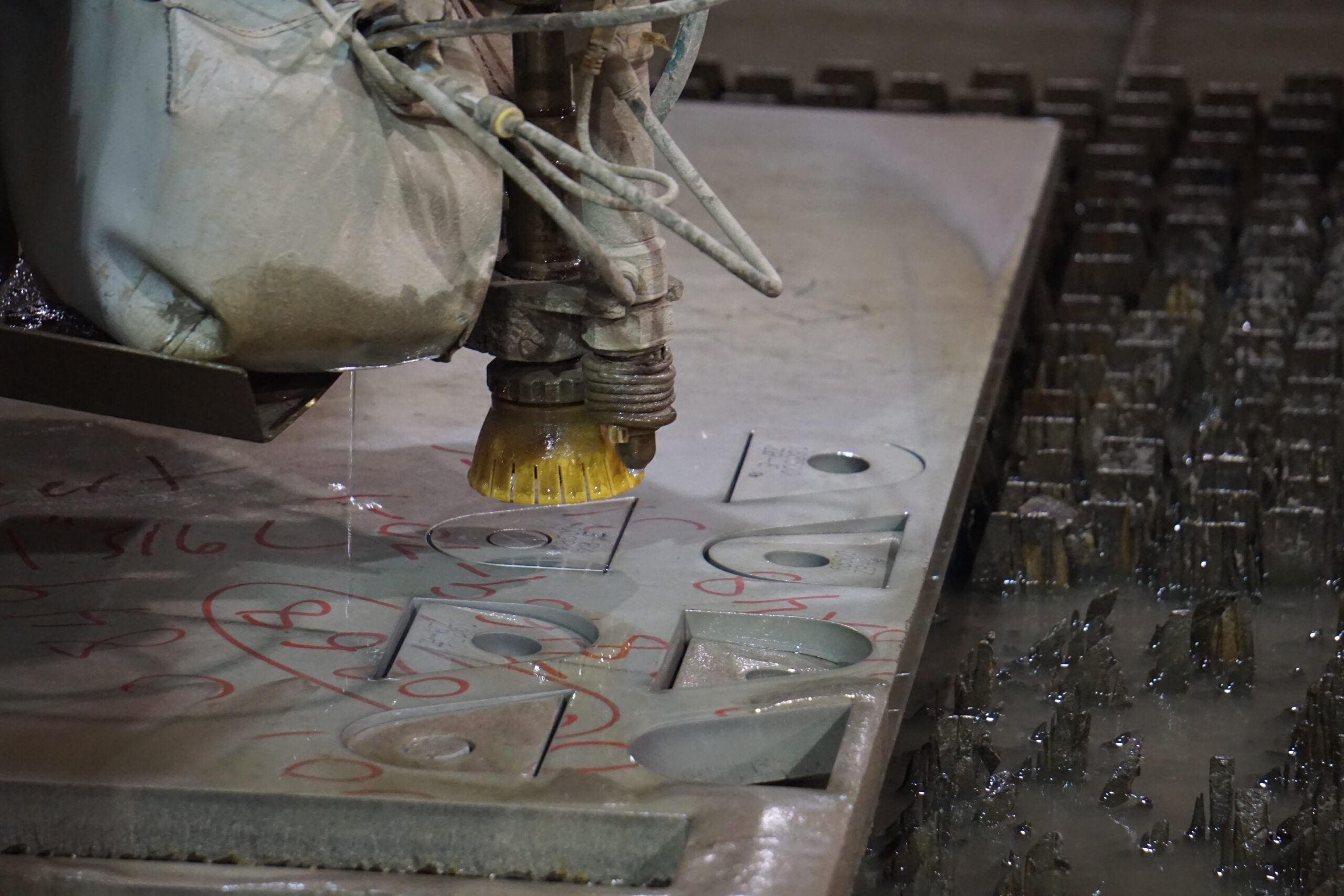
Another standard method for sheet metal cutting, waterjet cutting, offers heat-free, high-precision results.

Range of Material Thickness

Our waterjet cutting services allow us to cut a range of materials – including metals, wood, glass, and composites – from 1/16 inches thick to 6 inches thick. 

Exceptional Accuracy

Waterjet and laser cutting are comparable in terms of accuracy, surpassing plasma cutting in this area.

No Heat Affected Zone

One of the primary value-adds of this process is its ability to cut material without melting, distorting, or warping it. Depending on the type of metal or the part’s intended end use, no exposure to heat could be the main selling point for waterjet cutting.

Considerations for Waterjet Cutting

While waterjet cutting offers its share of benefits, it’s essential to consider the following before opting for waterjet cutting:

  • Cost: Waterjet cutting is a labor-intensive process, and the additional labor cost makes it the most expensive of the three metal cutting procedures.
  • Speed: Of all the metal cutting services we offer at MFP, waterjet is the slowest process.

Plasma Cutting Services

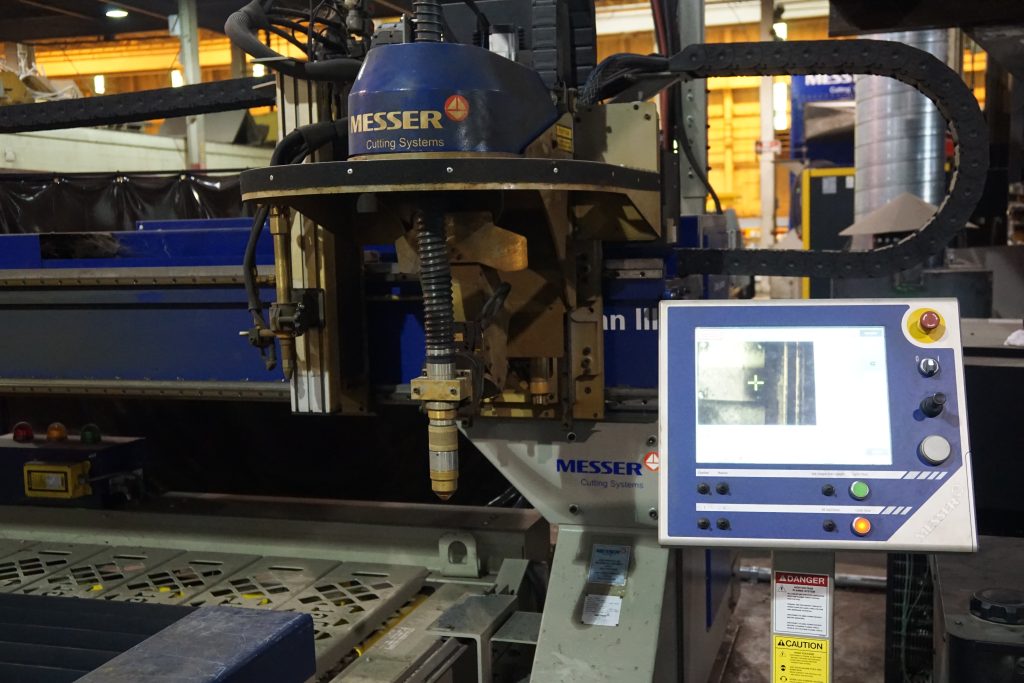
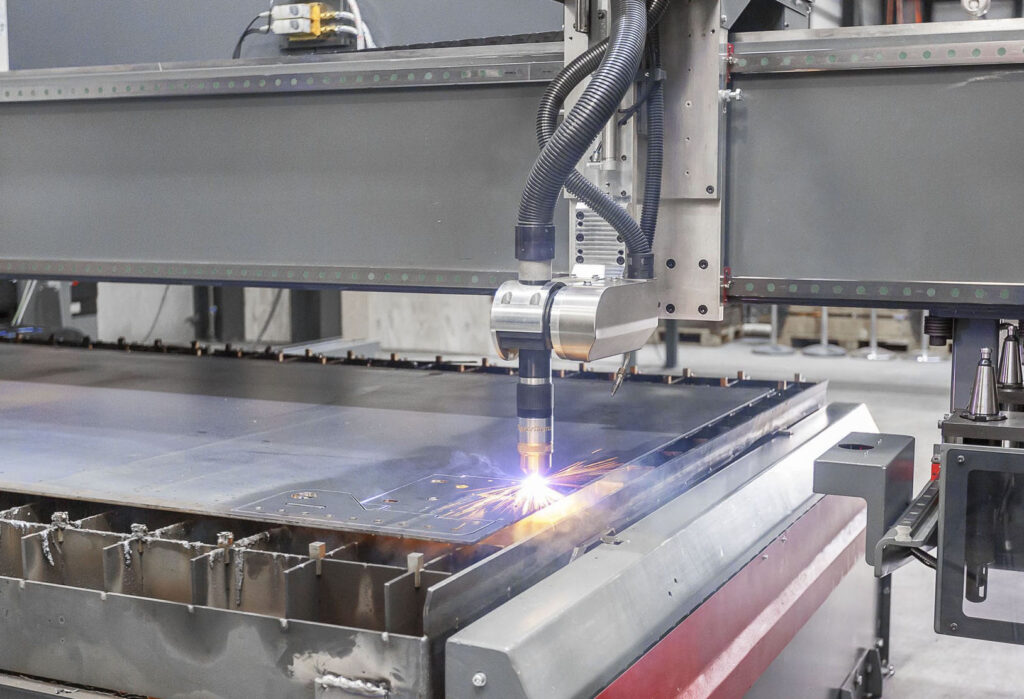
Our metal fabrication shop has a “Messer” high-precision cutting machine that offers efficiency and cost-effectiveness.

Cost-Effectiveness

While we often default to our laser cutting services, customers may request plasma cutting to reduce costs. 

Flexibility of Material

Our plasma cutting equipment offers us the ability to cut a range of sizes and thicknesses.

Stainless steel cuts from 12 gauge to…

  • 1 ¾” thick for pierce cut
  • 2” thick for edge start

Mild steel cuts from 16 gauge to…

  • 2” thick for pierce cut
  • 2 ¼” thick for edge start
  • Or up to 6” thick via torch burning

Aluminum cuts to…

  • 1 ½” thick for pierce cut
  • 2” thick for edge start

Considerations for Plasma Cutting

It’s important to note that the cost reduction that occurs when customers opt for plasma cutting services comes at a different price: less accuracy and precision. Particularly when cutting thicker materials up to 6 inches thick, adding a torch head can achieve these cuts but will increase the heat affected zone and widen the tolerance for these cuts, sacrificing precision.

Bear in mind that plasma cutting is a good choice for sheet metal cutting when tolerancing isn’t an issue.

Leverage MFP’s Expertise in Sheet Metal Cutting

By looking at the print, our team can determine the best cutting method based on the customer’s needs and the part’s specifications. This expertise not only ensures customers receive the best parts, but it could also yield positive results regarding speed or cost.

For instance, we occasionally receive drawings that request waterjet cutting on pieces less than one inch thick, even when a heat affected zone is permitted. In cases like this, our team will contact the customer to inquire about any outstanding reasons why they require waterjet cutting, only to find out that the customer developed this print long ago, before laser cutters could handle materials up to one inch thick. When we offer laser cutting services as an alternative, our customers will often jump at this opportunity, as it produces parts of the same quality but at a significantly lower cost.

This is where MFP’s expertise comes into play. Because we have such an in-depth understanding of our machinery and the results it produces, we can offer better options for our customers.

Request a quote to get started with Metal Fabrication Professionals. 

Laser vs. Waterjet vs. Plasma: Which of Our Metal Cutting Services Best Suits Your End Use? Read More »

high-volume production

Why Metal Fabrication Professionals Excels at High-Volume, Repeat Production Runs

At Metal Fabrication Professionals, we pride ourselves on our ability to excel at handling larger production runs and repeat work. This capability is mainly due to the advanced automation and equipment we have invested in over the years.

Continue reading to discover how our precision metal fabrication services are a perfect fit for high-volume, repeat production.

Why MFP Is Suited for High-Volume Production

We’ve invested heavily in cutting-edge equipment to support the high-volume production of components. Let’s explore some examples:

Lights-Out Production with Our Automation Cell 

One of the critical pieces of equipment that sets us up for high-volume production is the automation cell we’ve added to our laser cutter. This system is designed to load and unload material efficiently and automatically, allowing us to operate lights out. Here’s why this capability is particularly beneficial for higher volume production runs, as well as repeat work:

  • Shorter lead times: Our production process becomes significantly faster with automated material handling. As a result, our team can deliver parts to our customers more quickly.
  • Reduced labor costs: Operating unmanned and lights-out minimizes the need for manual labor. This efficiency translates into cost savings, which we pass on to our customers.
  • Consistency and precision: Automation ensures that each piece is produced with the same high level of accuracy and consistency – making it a perfect fit for higher volumes of repeated work.

Robotic Welding Capabilities for High Volumes

high-volume production

Another major asset we have on the shop floor is our robotic welder. This equipment is ideal for high-production runs, allowing us to handle larger quantities more productively.

Our robotic welding capabilities are most effective in larger volume projects where the investment in necessary fixtures is fully justified. While creating the fixtures for robotic welders can be a significant upfront expense, this cost is distributed across larger production runs. This makes robotic welding a highly cost-effective solution for high-volume projects, ensuring optimal efficiency.

Why MFP Is Equipped for Repeat Work

At MFP, our equipment and processes are designed to accommodate repeat work seamlessly. Here are some of the key features that enable us to excel in this area:

Our CNC Press Brake

Once programmed for a specific part, our CNC press brake can consistently produce thousands of parts with minimal manual intervention, making it a critical piece of equipment for high-volume, repeatable work. 

Large Quantities of Material On-Hand

Our setup allows us to keep material on hand for clients with repeat orders, ensuring we start production without delays. We also have access to a large steel inventory, further aiding our ability to handle repeat work efficiently. 

Versatility in Production

While we excel in high-volume production, we also have the flexibility to take on smaller, more custom orders. Our team can do it all:

  • Custom, small batches: Our skilled team and advanced equipment can handle intricate, custom orders with precision. 
  • High-volume production: Our automated processes and high-capacity machines ensure efficiency and consistency for repeatable work.

Metal Fabrication Professionals is an ideal partner for customers seeking large production runs and repeat work. Whether you need custom parts in small batches or high volumes, MFP has the equipment, expertise, and dedication to deliver exceptional results.

Request a quote from MFP to get started.

Why Metal Fabrication Professionals Excels at High-Volume, Repeat Production Runs Read More »

Scroll to Top